what does a balance hole do to a bowling ball
Permit's get-go with a quick question: Have you always heard a young man bowler say whatever of the post-obit statements?
- "I but don't like balls with rest holes. They don't roll well for me."
- "I'm going to have a weight pigsty put in the side so my ball volition hook more."
- "You lot only need a balance hole if your brawl has likewise much side weight."
These types of statements range from slightly misinformed to 100% incorrect. Whenever I hear stuff like this, I know I'1000 talking to someone who really doesn't empathise how residuum holes work. That's OK, of course; no one person tin can maybe know everything about all topics. That'due south why nosotros're here – reading, learning, and trying to become the best bowlers, brawl drillers, and coaches we tin can be.
This article will attempt to provide a "crash form" in everything a bowler, pro shop operator, or coach needs to know about residue holes. I'll kickoff by discussing the current conventional thinking on residue holes, to provide the appropriate groundwork for the residuum of the commodity. Side by side, I'll show some "before and after" examples of what adding a balance hole can do to a brawl's motion. And, finally, I'll give you my full general thoughts on how you should think about rest holes so that you lot can more than often understand what effect a given hole will have BEFORE y'all waste matter your fourth dimension and money drilling it.
Disclaimer
I like to tell information technology like it is. So, before we get too far, I think it'southward helpful to ready some reasonable expectations. In full general, balance holes are naught more than a tool for fine-tuning ball motion. Unfortunately, yous probably aren't going to learn anything in this article that volition add 20 pins to your average, give you 10 boards more hook, or make you conduct the 10 pin 100% of the fourth dimension.
Notwithstanding, learning almost balance holes has very real and tangible benefits. A solid understanding of balance holes tin help y'all become more than out of your electric current arsenal. Residual hole cognition tin can help you make better layout choices. And, proper use of balance holes can assistance you lucifer up and have amend ball motility a fleck more oft than you might otherwise. These are all skilful and valuable things, of course, merely merely go along in mind that a well-placed rest hole is never going to be a substitute for proper execution.
In the cease, I promise yous'll walk away from this with not simply a better agreement of residual holes themselves, but also with an improved understanding of layouts, ball dynamics, and ball motion in full general. Permit'due south get started!
Conventional balance hole wisdom
In the commencement, residual holes (more than usually called "weight holes" dorsum in those times) were used about exclusively for the purpose of getting a drilled ball dorsum to inside the legal limits for static imbalance. Virtually commonly, a weight hole would be used to accept a ball with too much side weight and get it back downward to less than 1 ounce of side, which was and still is the maximum corporeality of side weight imbalance allowed by the then-ABC and the current USBC.
Erstwhile in the adequately recent past, ball drilling experts began to realize that a weight hole could also exist used to dispense a ball's RGs and differentials. This opened upward a earth of possibilities for what could be done with a residuum pigsty. The focus was shifted, and the purpose of a balance hole was no longer primarily to make a ball's static weights legal. Balance holes began being used to significantly alter ball motion.
The most popular balance hole system or methodology in apply today is the Gradient Line Balance Pigsty system, developed originally by Mo Pinel and his collaborators during his years owning and operating MoRich Enterprises. In brusque, this system defines four standard rest hole positions (P1, P2, P3, and P4) that can be used to alter the motion of the brawl:
- P1 holes slightly weaken the ball's motion by reducing its differentials and cutting down on its track flare.
- P2 holes take almost no effect.
- P3 holes moderately strengthen the brawl'due south motion past moderately increasing its differentials and moderately increasing its rails flare.
- P4 holes significantly strengthen the ball's motility by significantly increasing its differentials and significantly increasing its rails flare.
Of course, prior to the development of the Slope Line system, many of the more highly-skilled brawl drillers already understood the basics of balance holes. They knew, for example, roughly where to put the extra hole to strengthen the reaction, and roughly where to put it to weaken the reaction. The Gradient Line arrangement just gave a bit more structure to the process of picking a balance hole position. Instead of having an unlimited number of possible residue hole locations to selection from, ball drillers at present had four standard positions, and each of them produced a certain outcome. All in all, the Gradient Line Balance Hole system was a big pace forward, equally information technology gave united states of america a common vocabulary and framework from which to work. That's a heck of a lot meliorate than everything that came before information technology, and I would strongly recommend that all bowlers and ball drillers familiarize themselves with the nuts of this system.
Balance hole examples
I'd like to walk through a few hypothetical scenarios to illustrate how diverse rest holes will affect a bowling ball'due south on-lane motility.
As some of you know, I've spent an unreasonably large number of hours over the concluding five or six years studying the physics of bowling ball motion, culminating in the development of a software tool called Powerhouse Blueprint. In short, this piece of software is a bowling ball motion simulator. It implements a very complex set of equations that govern the motion of a drilled bowling brawl, allowing for accurate studies such as this one that isolate the causes and effects of ball motion. It'south my tool of pick for demonstrating ball motion-related concepts, though I will admit to beingness a fleck biased as ane of its creators. All of the images and simulation data shown below were generated using a not-yet-released development version of Pattern.
These examples all use a hypothetical symmetrical bowling ball with an RG of 2.54″ and a total differential of 0.041″. Information technology volition exist "thrown" by a hypothetical bowler who has a ball speed of eighteen mph, a rev rate of 300 RPM, fifty degrees of axis rotation, 10 degrees of tilt, and a positive axis point (PAP) of 4.5″ over and 0.5″ upward. All of the simulations shown use the exact same oil pattern and all deliveries are thrown forth the verbal same target line. In other words, the only things that are changing from one example to the next are the layouts and residuum holes.
Symmetrical ball, fifty 10 5.5″ x 65 (layout A), no balance hole
In this first instance, allow's outset by drilling our brawl with a fairly weak pin-down layout with Dual Angle parameters of 50 x 5.five″ x 65 (which we'll refer to throughout as "layout A"). This ends up being a fairly low-flaring configuration, having a total track flare of virtually ii.vii inches.
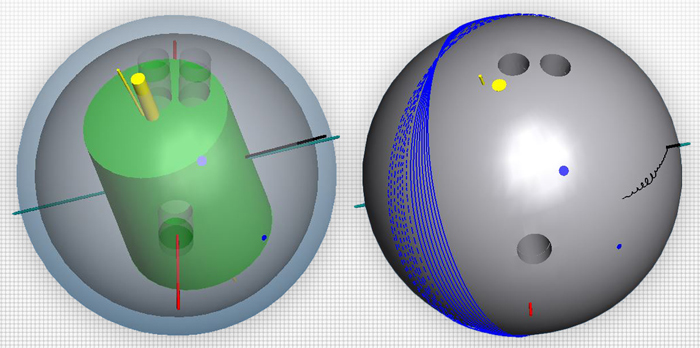
fifty x 5.5″ ten 65, no rest hole
Below is a brusk video showing how this ball reacts on-lane. Note that in this video and all the others that follow, the same exact shot is shown three times in a row. Also, notation that these videos are probably best viewed in total-screen mode, with the quality set up to full 1080p Hard disk drive fashion.
As shown, this ball manages to get support to the pocket, but information technology hits a bit low-cal. Specifically, it gets upwards to board 16.15 at 60 feet, with an entry angle of 5.iii degrees.
Symmetrical ball, l x five.5″ x 65 (layout A), flare-decreasing residuum hole
At present, permit'due south add a flare-decreasing balance hole to this ball. Specifically, this hole is 1 inch in diameter and three inches in depth, located slightly above the bowler's PAP on the vertical axis line. In terms of the Gradient Line Balance Hole system, this hole is approximately in the P1 position.
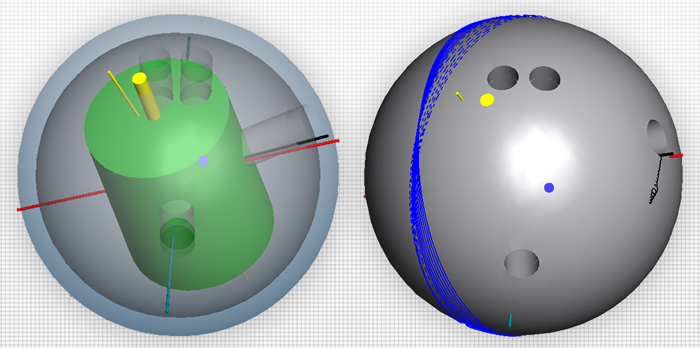
50 ten 5.five″ 10 65, flare-decreasing residuum hole
As the picture above shows, calculation this residuum pigsty does in fact cutting down on the ball's overall track flare, taking it from 2.7 inches of full flare before the addition of the hole to well-nigh i.vi inches of total flare after. Let's take a look at what that translates to in terms of ball motion:
Thanks primarily to the flare reduction, this ball hooks most two boards less than it did before adding the hole. Information technology doesn't quite make it back to the pocket and ends upwardly on board 14.24 at lx anxiety, with a lower entry bending of four.5 degrees.
Symmetrical ball, 50 x v.five″ x 65 (layout A), flare-increasing balance hole
Next, let's expect at how a flare-increasing hole affects this ball. This fourth dimension, our balance hole is 1.125 inches in diameter and 3 inches in depth, with a location of most 2 inches to the right of the thumb hole. This hole position corresponds approximately to the P3 location in terms of the Gradient Line Balance Pigsty Organisation.
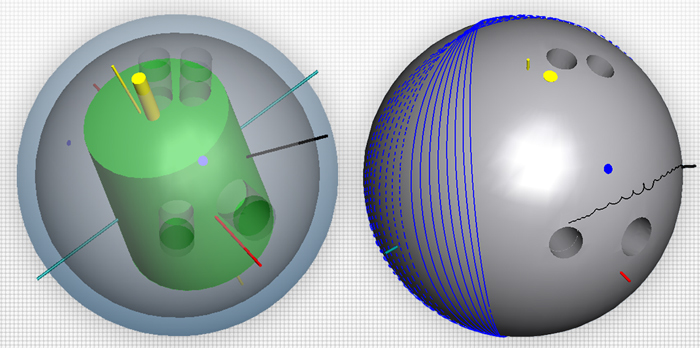
50 ten 5.5″ 10 65, flare-increasing balance hole
Once again, just every bit we expected, this flare-increasing residual pigsty caused our ball to flare quite a bit more than it did without the hole. Specifically, the addition of this hole increased our overall amount of track flare from ii.7 inches to v.three inches! If yous expected that this would lead to an increase in total claw, y'all'd be right:
Our ball now hits the pocket very loftier-flush, inbound at the 17.ix board with an entry angle of 4.9 degrees.
So far and then good, right? Let's briefly summarize our results thus far. With layout A, our flare-reducing rest pigsty cut our total hook past almost two boards, and our flare-increasing balance pigsty gave us almost 2 boards of extra hook.
Symmetrical brawl, 60 x 4″ ten xxx (layout B), no residue hole
Let's shift gears now and echo the above sequence of experiments, simply this time using a much stronger layout. This pin-up layout (which we'll refer to as "layout B") measures in at 60 x 4″ 10 xxx and produces nearly five.8 inches of total runway flare.
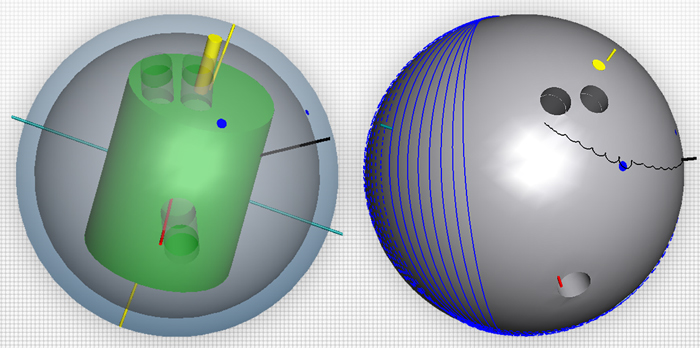
60 x 4″ x 30, no residuum pigsty
Just like earlier, let'due south accept a wait at its on-lane move. Again, nil has changed from before except the layout:
As we might take expected, this brawl out-hooks all three of our previous balls that used the much-weaker layout. Information technology hits a bit high in the pocket, inbound on the 18.8 board with an entry angle of v.viii degrees.
Symmetrical ball, 60 ten 4″ x 30 (layout B), flare-decreasing residual hole
Just as earlier with layout A, let's add the same flare-reducing balance hole:
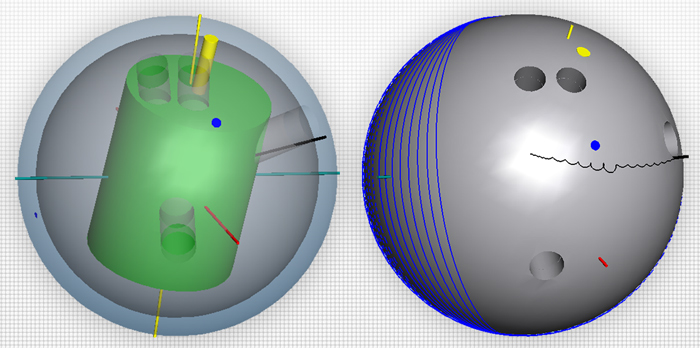
60 ten 4″ x 30, flare-decreasing balance hole
As expected, this balance hole cut down our rail flare a bit, taking information technology from 5.8 inches downward to 5.ii inches…
…and, in terms of on-lane motion, the add-on of this flare-reducing hole caused a very slight decrease in total hook of nearly half a board. Specifically, this ball entered the pocket on the 18.iii board with an entry angle of five.2 degrees.
Symmetrical ball, 60 x 4″ x thirty (layout B), flare-increasing balance hole
Finally, nosotros'll add together our flare-increasing balance pigsty to this ball, as shown below.
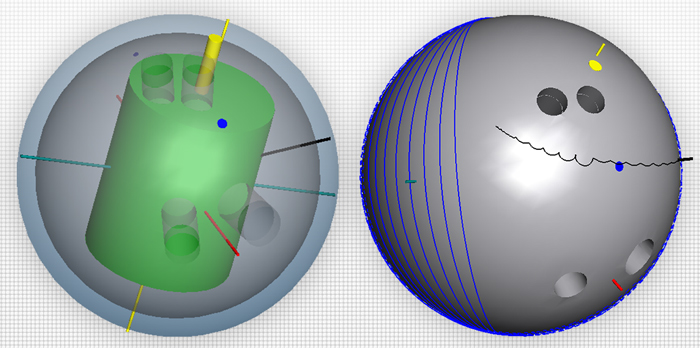
sixty x 4″ 10 30, flare-increasing balance pigsty
The improver of this hole does in fact increase our ball's track flare, taking it from 5.viii inches upward to 7.i inches.
As the video shows, notwithstanding, this increment in runway flare did not translate into an increase in full hook. In fact, the improver of this hole reduced the total hook past 0.half-dozen boards, with it inbound the pocket on the 18.2 board with an entry angle of 5.ane degrees.
How can this be? The ball flared more, simply it hooked a piffling bit less. What happened? Permit's dig a bit deeper.
Not all identical residual holes are created equal!
When we add together a residue hole to a brawl, several things are happening simultaneously:
- Nosotros're reducing the weight of the ball by a modest amount: This is insignificant and unimportant almost 100% of the fourth dimension, and so we'll ignore it.
- Nosotros're moving the brawl'due south center of gravity: This is the initial reason remainder holes exist, after all, and it's still true today that adding a balance pigsty to a ball changes its static imbalance.
- We're changing the ball's mass moments of inertia: In bowling parlance, we're irresolute its RGs, its differentials, and the orientation of its minimum and maximum RG axes.
In our first set of examples above using layout A, we did the post-obit:
- We took a low flaring ball and turned information technology into a very low flaring ball past adding the flare-reducing balance hole. This made the brawl hook significantly less.
- We so took a low flaring ball and turned it into a high flaring ball by adding the flare-increasing balance pigsty. This made the ball hook significantly more than.
With this layout, we were operating down at the low end of the track flare spectrum. In adding the two residue holes to this layout, the amount of runway flare difference we saw caused big differences in ball motility. Going from a depression flare state of affairs to a medium flare situation causes the ball to feel significantly more friction at the back cease when it exits the cease of the oil pattern, due to the ball contacting the lane on a fresh dry contact patch a much higher pct of the time equally a result of the increased rail flare.
In our second gear up of examples using layout B, we did the following:
- We took a high flaring ball and turned it into a slightly less high flaring ball by calculation the flare-reducing balance hole. This made the ball hook just slightly less.
- We then took a high flaring ball and turned it into a very loftier flaring ball by adding the flare-increasing balance hole. This besides made the brawl hook just slightly less.
With this layout, we were operating at the very high end of the track flare spectrum. The modify in friction experienced past the ball at this finish of the spectrum is incredibly minimal. This is a flake of an exaggeration, merely think of it this style: the ball without the balance hole was already contacting the lane on fresh dry surface 99% of the time. When we added the flare-increasing hole, we widened the flare rings slightly, simply nosotros're at a betoken of extremely diminishing returns here. The slightly wider flare rings contribute nil 99% of the time, because they were already fully separated. It'south true that in that location is an extremely minor friction increase each fourth dimension the ball approaches the bowties; perhaps at present nosotros could say information technology is touching the lane on fresh dry surface 99.ane% of the time instead of 99% of the time. But this, as you could probably imagine, has about no effect at all on the ball's movement.
Then, we've solved part of the riddle. Nonetheless, nosotros haven't answered why the layout B ball actually hooked a little flake less when we added the flare-increasing balance hole. The main reason is that the addition of this pigsty shifted the ball'south CG and changed its static imbalance. The CG position of the brawl with the flare-increasing hole produced just slightly less hook than the CG position of the ball without the pigsty. The reason is that this shift in CG position made the ball lose centrality rotation angle slightly faster than information technology did without the hole. The outcome of this CG shift is fairly small – less than one board in total hook – only it is still an effect, nonetheless. And, since it wasn't offset by a large friction increase, information technology became the dominant gene in what altered the motion of the ball in this example.
Suggested manner to call up about balance holes
Thinking about what a given balance hole will do to the dynamics of a bowling ball is a expert and very reasonable first pace. Nevertheless, nosotros shouldn't stop in that location. Differentials affect rail flare, and track flare can dramatically affect ball motion. So, differentials are just a means to an end. What we should actually intendance about is how the addition of the balance hole will impact the brawl'due south motion.
The key point hither is to empathise that at that place is a very non-linear relationship between rail flare and ball motion. In other words, an extra inch of rails flare doesn't always produce the same effect in terms of on-lane motion. Go from 1 inch of flare to 2 inches of flare and you'll likely run across a significant increment in total hook. Become from 6 inches of flare to 7 inches, however, and you probably won't see any measurable difference at all in on-lane motion. When considering residue holes (and really, layouts in general), it's of import to think about where the ball will fall on the track flare calibration both before and afterward calculation the pigsty.
Consider the following, which shows a rough graphical approximation of how full rails flare translates into ball motion:
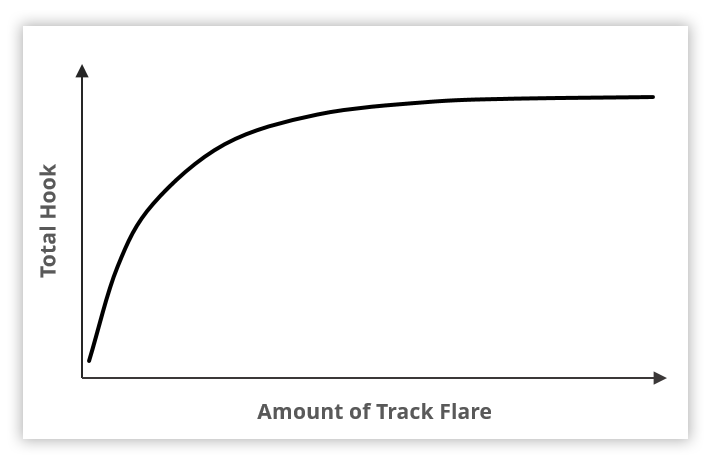
The human relationship between rail flare and total claw is very non-linear.
Here, we've labeled "full hook" on the vertical centrality, simply it could have merely every bit appropriately been labeled "response to friction" or whatever other term you adopt that signifies strength. The point here is that it matters where your ball is on this curve if you're thinking virtually trying to alter its motion with a remainder hole. In our start prepare of examples (using layout A), our brawl was over on the left side of the curve; small changes in flare in either direction resulted in significant changes in total claw. In our second set up of examples (using layout B), our ball was over on the right side of the curve; small-scale changes in flare in either direction had almost no effect on the ball'due south total hook.
Conclusions
We've certainly covered a lot of ground here, but earlier we call it quits, I recollect it'due south important to mention some small caveats:
- In this article, I've presented a framework for thinking nearly how traditional rest holes can touch on brawl motion, just it certainly isn't 100% correct. After all, there are ever outliers and exceptions. That said, the model presented is quite useful in the real world. Nosotros certainly could accept had a much more complicated discussion on this topic, but that wasn't the intent. The intent was to requite you the 20% of information that gives you fourscore% of the results. The more complicated other 80% tin be covered in a time to come article.
- Nosotros focused nearly entirely on how track flare directly affects ball motion via its influence on the amount of friction the ball experiences. In doing so, we've taken a fairly simplified approach of looking merely at total track flare (that is, nosotros didn't talk near finer details like flare in the oil vs. flare on the back end). Also, we didn't talk nearly some of the other side effects of runway flare that aren't at all related to friction. Some of these details can exist of import in some situations, but we'll leave these sorts of topics for hereafter discussions. Once again, the focus was to give you the fourscore/twenty of how residual holes affect ball motility, so these finer details were left out intentionally.
- We looked at a very limited data set up in this article. Basically, we covered 2 layouts, using ane bowler, using 1 symmetrical bowling ball. Nosotros didn't look at a broad variety of layouts, we didn't cover lots of different bowler styles, and we didn't look at multiple types of bowling balls (such as asymmetricals, for example). That said, the full general concepts we discussed and the conclusions nosotros reached should, in general, exist fairly broadly applicative.
I promise you stuck with us and gained at least some appreciation for the importance of balance holes in modern bowling. Balance holes are just one of many tools that bowlers have at their disposal for fine-tuning their ball motion. Understanding how they contribute to ball move can help you make better equipment decisions, which ultimately tin can make you a amend bowler. And, if you happen to exist a pro store operator or coach, I really promise y'all learned some things here that will aid y'all better serve your customers.
Finally, allow me know what y'all thought of this commodity. Exit me a annotate below and share your thoughts.
Source: https://www.bowlingthismonth.com/bowling-tips/bowling-ball-balance-hole-fundamentals/
0 Response to "what does a balance hole do to a bowling ball"
Post a Comment